Friday, March 30, 2012

Snowboarding in Afghanistan

The skiing in Afghanistan is superb due to the cold winters and for most of the time, lovely crisp powder snow. I did quite a bit of skiing and climbing in Afghanistan between 1993 and 1996 and have written many articles. The previous link gives a good description of the Hindu Kush and the people.


Skiing near the Salang Pass Afghanistan in early 1996. Photo: Bob McKerrow collection.

Therefore I was delighted to read in the New Zealand website stuff.co.nz, that a group of young New Zealanders have been snow boarding in Bamiyan. This must be a snowboarders heaven. Here is their story.
 
AIR RAID: Kiwi snowboarder Clint Allan jumps over a house in Koh-e-Baba mountains, Bamiyan province, Afghanistan, a province wracked by war since 2002.

A gaggle of villagers deep in the mountains of central Afghanistan stared in wonder as a professional snowboarder from New Zealand launched himself over half a dozen young children, two of them perched atop donkeys.

It was one of the oddest interactions between foreigners and Afghans in the decade since US-led forces invaded the country, and the result of a surprising tourism push in a country at war.

International aid workers and enterprising locals are trying to attract snowboarders and skiers to the untouched slopes of the Koh-e-Baba mountains to improve the fortunes of Bamiyan province - the site of towering Buddha statues destroyed by the Taliban in 2001, and one of Afghanistan's poorest provinces.

It's no surprise that challenges abound.

Though Bamiyan is largely peaceful, it's tough to convince any but the most adventurous travellers to come to war-torn Afghanistan. Once visitors land in the capital, Kabul, they face the tricky prospect of catching a diplomatic or humanitarian flight since no commercial airlines fly to Bamiyan. A few hardy foreigners have braved the six-hour drive despite the threat of robbery and kidnapping.

There are no ski lifts, so every ascent requires a lung-busting climb up snow-covered mountains that rise to more than 5000 metres. Skiers climb up using "skins" - pieces of rough fabric stuck on the bottom of skis for traction. Snowboarders use special boards that split down the middle and then lock back together for the downhill.

 LEAP OF FAITH: Kiwi snowboarder Mitch Allan launches himself over a bunch of locals in Koh-e-Baba mountains, Bamiyan province, Afghanistan.

The writers of the definitive (and only) guide to skiing in Bamiyan also suggest the "donkey lift" - hiring a villager's donkey to carry you up the mountain.

The commercial guest houses open in the winter provide little more than a bed and a traditional wood-burning stove, and "apres ski" is limited to tea, kebabs and parlour games.

But the mountains are spectacular and provide seemingly endless runs down pristine slopes filled with nothing but the sound of the wind and the rush of skis against snow - a far cry from the crowded trails of American and European ski resorts.

This was the draw for a group of professional snowboarders from New Zealand and Australia who travelled to Bamiyan in late February to film a documentary. They were terrified when they arrived in Kabul, especially because of violent protests against US soldiers burning Korans that left more than 30 people dead.

"The amount of guns and razor wire that I saw on my way to the guest house from the airport only confirmed what I expected," said Alex Cameron, 22, editor of a snowboarding magazine in Sydney. "But stepping off the plane in Bamiyan, I felt completely safe."

Arriving in Bamiyan does feel a bit like being enveloped in a pastoral painting. The flight into Bamiyan city first makes a flyby of the gravel runway to make sure it is clear of animals and people. The plane lands with views on one side of the snow-covered Hindu Kush mountains, and the niches of the Buddha statues carved into sheer red cliffs on the other.

The snowboarders spent a week travelling with a local guide down Bamiyan's bumpy roads past clusters of mud brick houses looking for steep slopes to shoot down and things to jump, including cliffs, houses and, yes, donkeys - although it took some time to convince the animals' owner it was a good idea.

Once permission was secured, Clint Allan, 26, and his 24-year-old brother, Mitch, leapt off a jump built in the snow and soared about three metres in the air over the animals and local children.

The two tried to ride the donkeys afterward, provoking howls of laughter. They didn't have much luck getting the stubborn animals to move until a local kid started whacking the animals with a stick.

"It was sweet!" said the elder Allan.

Bamiyan attracted thousands of foreigners every year until the Soviet invasion in 1979 plunged the country into more than three decades of war. Tourists came to trek through the mountains, to picnic at dazzlingly blue Band-e-Amir lake and marvel at the Buddhas. But tourism was mainly limited to the summer, and skiing was unknown in the area.

There was some skiing near the capital, where a few enterprising Afghan skiers built tow ropes in the hills just outside Kabul. But they were abandoned after the Soviets invaded.

The push to make Bamiyan a skiing destination started in 2010, when the Geneva-based Aga Khan Foundation sponsored two Americans to write a guidebook. It has also trained locals to ski and hired internationally certified ski guides to take tourists into the mountains.

The new ski industry has had some economic benefit, although the numbers are still fairly small.

Gull Hussein, a 28-year-old entrepreneur, started a tourism company last year that offers a three-day ski package for US$315 ($NZ384). The deal includes lodging, local transport, ski rental and an international ski guide. About 70 foreigners have taken him up on the offer, most of whom travelled from Kabul.

Ali Shah Farhang has also benefited as Bamiyan's first local ski guide. The 20-year-old student started skiing about a year ago under the tutelage of an Italian guide brought by Aga Khan and has begun leading foreign clients into the mountains, including the professional snowboarders.

He receives $100 a month from Aga Khan and $30 per day when he is guiding clients, a significant sum in a country where a typical government bureaucrat in the capital makes $200 a month. For rural Bamiyan, it's a fortune.

"Foreign people are usually fighting the Taliban in Afghanistan, but in Bamiyan they are comfortable, they are skiing," Farhang said.

Thursday, March 8, 2012

Did our letter have an influence on President Obama?


Amid fresh concerns over the safety of American forces, President Barack Obama says the accidental burning of Korans in Afghanistan and the retaliatory killings of US troops gave new credence to the need to end the war.
I am wondering if the letter I, and a group of writers and experts on Afghanistan wrote to Obama of December 17, 2010, had any influence on him. See letter below or this link. To the President of the United States:  December 17, 2010

"I think that it is an indication of the challenges in that environment, and it's an indication that now is the time for us to transition," Obama said during a White House news conference.

Obama announced no speeding up of the NATO-backed plan to end combat missions in Afghanistan at the end of 2014, saying "that continues to be the plan". But he said the violence aimed at Americans in Afghanistan that followed the accidental burning of Korans on a US base was "unacceptable".

Six Americans were killed in retaliatory violence. Obama offered his apologies to Afghan President Hamid Karzai, a move that was roundly criticised by his Republican presidential rivals as weak and unnecessary.

From Congress, Obama was getting tugged from another direction. A letter calling for Obama to accelerate the withdrawal of US troops from Afghanistan had the backing of 23 senators, mostly Democrats but including two conservative Republicans, Sens. Mike Lee of Utah and Rand Paul of Kentucky.

HERE IS THE LETTER WE WROTE TO PRESIDENT OBAMA.

Mr. President,

We have been engaged and working inside Afghanistan, some of us for decades, as academics, experts and members of non-governmental organisations. Today we are deeply worried about the current course of the war and the lack of credible scenarios for the future. The cost of the war is now over $120 billion per year for the United States alone.

This is unsustainable in the long run. In addition, human losses are increasing. Over 680 soldiers from the international coalition – along with hundreds of Afghans – have died this year in Afghanistan, and the year is not yet over. We appeal to you to use the unparalleled resources and influence which the United States now brings to bear in Afghanistan to achieve that longed-for peace.

Despite these huge costs, the situation on the ground is much worse than a year ago because the Taliban insurgency has made progress across the country. It is now very difficult to work outside the cities or even move around Afghanistan by road. The insurgents have built momentum, exploiting the shortcomings of the Afghan government and the mistakes of the coalition. The Taliban today are now a national movement with a serious presence in the north and the west of the country. Foreign bases are completely isolated from their local environment and unable to protect the population. Foreign forces have by now been in Afghanistan longer than the Soviet Red Army.

Politically, the settlement resulting from the 2001 intervention is unsustainable because the constituencies of whom the Taliban are the most violent expression are not represented, and because the highly centralised constitution goes against the grain of Afghan tradition, for example in specifying national elections in fourteen of the next twenty years.

The operations in the south of Afghanistan, in Kandahar and in Helmand provinces are not going well. What was supposed to be a population-centred strategy is now a full-scale military campaign causing civilian casualties and destruction of property. Night raids have become the main weapon to eliminate suspected Taliban, but much of the Afghan population sees these methods as illegitimate. Due to the violence of the military operations, we are losing the battle for hearts and minds in the Pashtun countryside, with a direct effect on the sustainability of the war. These measures, beyond their debatable military results, foster grievance. With Pakistan’s active support for the Taliban, it is not realistic to bet on a military solution. Drone strikes in Pakistan have a marginal effect on the insurgency but are destabilising Pakistan. The losses of the insurgency are compensated by new recruits who are often more radical than their predecessors.

The military campaign is suppressing, locally and temporarily, the symptoms of the disease, but fails to offer a cure. Military action may produce local and temporary improvements in security, but those improvements are neither going to last nor be replicable in the vast areas not garrisoned by Western forces without a political settlement.

The 2014 deadline to put the Afghan National Army in command of security is not realistic. Considering the quick disappearance of the state structure at a district level, it is difficult to envision a strong army standing alone without any other state institutions around. Like it or not, the Taliban are a long-term part of the Afghan political landscape, and we need to try and negotiate with them in order to reach a diplomatic settlement. The Taliban’s leadership has indicated its willingness to negotiate, and it is in our interests to talk to them. In fact, the Taliban are primarily concerned about the future of Afghanistan and not – contrary to what some may think – a broader global Islamic jihad. Their links with al-Qaeda – which is not, in any case, in Afghanistan any more – are weak. We need to at least try to seriously explore the possibility of a political settlement in which the Taliban are part of the Afghan political system. The negotiations with the insurgents could be extended to all groups in Afghanistan and regional powers.

The current contacts between the Karzai government and the Taliban are not enough. The United States must take the initiative to start negotiations with the insurgents and frame the discussion in such a way that American security interests are taken into account. In addition, from the point of view of Afghanistan’s most vulnerable populations – women and ethnic minorities, for instance – as well as with respect to the limited but real gains made since 2001, it is better to negotiate now rather than later, since the Taliban will likely be stronger next year. This is why we ask you to sanction and support a direct dialogue and negotiation with the Afghan Taliban leadership residing in Pakistan. A ceasefire and the return of the insurgency leadership in Afghanistan could be part of a de-escalation process leading to a coalition government. Without any chance for a military victory, the current policy will put the United States in a very difficult position.

For a process of political negotiation to have a chance of addressing the significant core grievances and political inequalities it must occur on multiple levels – among the countries that neighbour Afghanistan as well as down to the provincial and subdistrict. These various tables around which negotiations need to be held are important to reinforce the message – and the reality – that discussions about Afghanistan’s political future must include all parties and not just be a quick-fix deal with members of the insurgency.

We believe that mediation can help achieve a settlement which brings peace to Afghanistan, enables the Taliban to become a responsible actor in the Afghan political order, ensures that Afghanistan cannot be used as a base for international terrorism, protects the Afghan people’s hard-won freedoms, helps stabilise the region, renders the large scale presence of international troops in Afghanistan unnecessary and provides the basis of an enduring relationship between Afghanistan and the international community. All the political and diplomatic ingenuity that the United States can muster will be required to achieve this positive outcome. It is time to implement an alternative strategy that would allow the United States to exit Afghanistan while safeguarding its legitimate security interests.

Respectfully,

Matthieu Aikins Journalist

Scott Atran Anthropologist (University of Michigan) and author of Talking to the Enemy

Rupert Talbot Chetwynd Author of Yesterday’s Enemy – Freedom Fighters or Terrorists?

Robert Abdul Hayy Darr Author of The Spy of the Heart and humanitarian aid worker in Afghanistan during the 1980s and early 1990s.

Gilles Dorronsoro Visiting Scholar (Carnegie Endowment for International Peace) and author of Revolution Unending

David B. Edwards Anthropologist (Williams College) and author of Before Taliban

Jason Elliot Author of An Unexpected Light

Antonio Giustozzi Author of Koran, Kalashnikov and Laptop and editor of Decoding the New Taliban

Shah Mahmoud Hanifi Associate Professor, James Madison University

Daniel Korski Senior Policy Fellow, European Council on Foreign Relations

Felix Kuehn Kandahar-based writer/researcher, co-editor of My Life With the Taliban

Minna Jarvenpaa Former Head of Analysis and Policy Planning, UNAMA

Anatol Lieven Professor, War Studies Department of King’s College London and author of Pakistan: A Hard Country

Bob McKerrow Author of Mountains of our Minds – Afghanistan

Alessandro Monsutti Research Director, Transnational Studies/Development Studies at The Graduate Institute, Geneva

Ahmed Rashid Journalist and author of Taliban and Descent into Chaos

Nir Rosen Fellow, New York University Center on Law and Security

Gerard Russell Research Fellow, Carr Center for Human Rights Policy, Harvard University

Alex Strick van Linschoten Kandahar-based writer/researcher, co-editor of My Life With the Taliban

Astri Surkhe Senior Researcher, Chr. Michelsen Institute, Norway

Yama Torabi Co-Director, Integrity Watch Afghanistan

Jere van Dyk Author of In Afghanistan and Captive

Matt Waldman Afghanistan Analyst

Saturday, February 4, 2012

My Queen of Kabul - Nancy Dupree


Kabul, the city Nancy Dupree wrote a book on and fell in love with. Photo: Bob McKerrow

It has been most enjoyable and productive having Ebrahim Faghihi working with us on a Sri Lanka Red Cross flood recovery operation. Over dinner last night we spoke of those wonderful days in 95-96 when we spent time exploring Kabul with Nancy Dupree the great historian on Afghanistan and author of so many books on the country. Here is a photo I took of Ebrahim with Nancy in 1996 on the outskirts of Kabul..

I knew got to know Nancy in those difficult days in Kabul between 1993-96 when Nancy was living in Peshawar. She stayed at my house in Kabul on visits to Afghanistan a number of times and Ebrahim and I often did day tours of Kabul with her where she explained in minute details, every scrap of history she knew of.
Although working for the International Red Cross, I gave a lot of my spare time working with her and colleagues, rescuing treasures from the Kabul museum which was coming under bombing by the Talibans and looting from other warring factions. We also worked together on preserving the British (Foreigners) cemetary
in Kabul which hid a rich history from the time of the early Ango Afghan wars.
Honouring 45 years since the death of the great archaeologist Aurel Stein at his grave in the Kabul cemetary. Tim Johnston AFP (2nd from left) and Ahmed Gizo (right). We invited Nancy Dupree but was unable to make because of fighting in Kabul. Photo: Bob McKerrow

As I was able to travel freely in Afghanistan in the course of my work, I took photographs for Nancy of historic sites her and Louis thirty years earlier and brought her back photographs. She was so grateful and could never thank me enough.

When I published my book on Afghanistan in 2003 I dedicated it to "My Queen of Kabul, Nancy Dupree."

She was grateful to get a copy of my book but I much more grateful to have autographed copies of all her books, which guided me through Afghanistan.

She would tell me over a wine at nights of her love affair with Afghanistan and her late husband Louis Dupree. These were romantic evenings around a log fire in Kabul, with a woman 20 years older than me, recounting her early and carefree days of the 1960s.

.
Kabul the city that Nancy Dupree fell in love with. Photo: Bob McKerrow
I haven't seen Nancy for 14 years but we kept in touch by email for a long time. Who better to tell her love story than C.M. Sennott from the GlobalPost who published this article in June 2009.

En­ter the steel gates that lead to the court­yard and well-tended gar­dens of a faded, but still el­e­gant, manse where Nancy Hatch Dupree greets us on the steps.

For a mo­ment, you feel what it must have been like to live here in the early 1960s.

That’s when Dupree first ar­rived in Kabul and where she would meet the two great loves of her life. The first was her hus­band, Louis Dupree, the dash­ing Amer­i­can para­trooper turned world-fa­mous arche­ol­o­gist. The sec­ond love was one they both shared: the cul­tural and his­toric riches of the rugged, mag­i­cal land­scape of Af­ghan­i­stan and its peo­ple.


As an arche­ol­o­gist and eth­nol­o­gist, Af­ghan­i­stan has been the fo­cus of their life’s work.
She and Louis, who passed away in 1989, lived through it all and suf­fered with the Afghans through the wars and cel­e­brated the life that has gone on in be­tween. She sur­vived the dark days of the civil war here in the early 1990s and the even darker days of the Tal­iban. Through it all, she stud­ied and worked to pro­tect and pre­serve the coun­try’s cul­ture and her­itage. To­day, there is no West­erner who knows the Afghan peo­ple like Nancy.

Some 45 years af­ter her ar­rival here, I meet with Dupree on a sunny day in the late af­ter­noon shad­ows of the once-grand home where she lives part of the year in down­town Kabul.

The rest of the year she lives just across the bor­der in Pe­shawar, Pak­istan, still writ­ing and re­search­ing at the age of 83. She di­vides her time be­tween the two cities, tend­ing an archive that is housed at Kabul Uni­ver­sity. The archive, an idea in­spired by Louis, is ded­i­cated to cre­at­ing a re­source cen­ter for all the dif­fer­ent aid work­ers and Afghan ex­perts who could no longer travel freely in war-torn Af­ghan­i­stan.

She looks heart­sick when she talks about the Tal­iban’s de­struc­tion of the two gi­ant Bud­dha carv­ings of Ba­mayan. She also wants to set the record straight that she was ne­go­ti­at­ing with the Tal­iban lead­er­ship to pro­tect the Bud­dhas, and be­lieves the de­ci­sion to dy­na­mite them was made by a mil­i­tant fringe closely con­nected to Al Qaeda. She in­sists that many in the Tal­iban gov­ern­ment were op­posed to the de­struc­tion, but the mil­i­tants had run away with the Tal­iban move­ment.


I did day trips with Nancy out towards the Jebal Seraj in winter to view the mighty Hindu Kush. Photo: Bob McKerrow

She holds the se­crets to so much of the pol­i­tics that has gone on in Af­ghan­i­stan, but at every turn the con­ver­sa­tion comes back to the Afghan peo­ple and her love for and fas­ci­na­tion with them and their his­tory.

"I’m a peo­ple per­son," says Nancy, who apol­o­gizes that she doesn’t have much time to talk as she is head­ing out to a party at the em­bassy to meet the newly ap­pointed Amer­i­can Am­bas­sador, Karl Eiken­berry, who also served as the com­mand­ing gen­eral in Af­ghan­i­stan.

Right away, she wants to get into it.

Nancy still has a lot of fire in her voice and she has some stern crit­i­cism of the U.S. mil­i­tary and diplo­matic ap­proach in Af­ghan­i­stan.

"They make strate­gies for peo­ple who they don’t talk to," she says, sit­ting on a couch in the par­lor where we are talk­ing and lean­ing for­ward with in­ten­sity.

"They sit be­hind the fortress with ra­zor wire walls of the Em­bassy. And the rest make their strat­egy from be­hind desks thou­sands of miles away … They don’t seem to re­al­ize that the strat­egy has to be about the peo­ple," she says.

She checks her watch and says, "Sorry, I have to go put on my face now and get ready for all the diplo­mats. Too many of them, if you ask me."

Mo­ments later she heads out through the steel gate, look­ing el­e­gant in a long, tra­di­tional em­broi­dered gown. She slides into the back seat and she and her dri­ver head out down the crowded, chaotic and some­times-per­ilous streets of Kabul, the city she loves.

Monday, January 30, 2012

Some new old photos of Afghanistan

Over the weekend I was sorting out colour slides and scanning them. Here are a few from 1976 and my three years (1993-96) later.
On top of the Subzak Pass in 1994. The passes of the Paropamisus in the west are relatively low, averaging around 600 meters; the most well-known of these is the Sabzak between the Herat and Badghis provinces, which links the western and northwestern parts of Afghanistan. Photo: Bob McKerrow


                                       Kabul in early winter 1996. Photo: Bob McKerrow
Coming down from the Khawak Pass in the footsteps of Alexander the Great with my good friend Lola. Photo: Bob McKerrow

The damage that was caused in Kabul was tragic to witness in the early 1990s. Photo: Bob McKerrow


I first visited Afghanistan in 1976 when I was working with the Red Cross in Geneva to assist the Afghan Red Crescent on an earthquake relief operation in Samanghan. here I am in the bazaar in Herat. Photo: Bob McKerrow


Thursday, December 15, 2011

Who is killing Afghanistan?

The Blue Mosque in Mazar-I-Sharif which is a Shrine to Ali and revered by the Shia Muslims.  Taken in 1976 when I was working for the Red Cross after a major earthquake in the north. Photo: Bob McKerrow

Bombs kill 58 in Kabul and Mazar-i-Sharif. The BBC's Quentin Sommerville: "It seems this was a co-ordinated attack; it certainly seems to have a sectarian element"

Twin attacks apparently targeting Shia Muslims have killed at least 58 people in Afghanistan.

In the deadliest incident, a suspected suicide bomb struck a shrine packed with worshippers in the capital, Kabul, killing at least 54.

Another blast hit the northern city of Mazar-i-Sharif at about the same time, killing four people.

The attacks appear to be of a sectarian nature unprecedented in recent Afghan history, correspondents say.

They coincided with the Shia Muslim festival of Ashura - the most important day in the Shia calendar and marked with a public holiday in Afghanistan.

Ashura is the climax of Muharram, the month of mourning for the martyrdom of the Prophet Muhammad's grandson.

The police have cordoned off all roads to the blast site in the medieval Murad Khani district where many Shias had gathered to commemorate Ashura at the Abu Fazal mosque.

Here, at an emergency surgical centre just 10 minutes from the site, people are gathered crying and wailing. I have heard women shouting: "My son is dead, my son is dead." I have seen people with charred clothing.

Security forces have been ferrying victims to waiting ambulances. There are many wounded too. Those who were there say there are a lot of casualties. People are gathering in front of the hospital and the police are on the streets around here controlling the traffic.

Though tensions exist between Afghanistan's Sunni and minority Shia Muslims, most attacks in Afghanistan in recent years have targeted government officials or international forces, correspondents say.


When I lived for three years in Afghanistan (1993-96) I visited the Abu Fazal mosque in Kabul one of the places of today's atrocities, and the Blue Mosque in Mazar-i-Sharif. The book I wrote on Afghanistan provides prose, poetry and photographs of my favourite country and the peaceful nature of the people. Why this today?

Children hit

The near-simultaneous explosions happened at about midday (07:30 GMT).

In Kabul, the bomb went off near a gathering of hundreds of Shias singing at the Abu Fazal shrine.

Fifty-four people were killed in the blast, said health ministry spokesman Norughli Kargar, while 150 were injured.

"It was very loud. My ears went deaf and I was blown three metres [yards]," Mustafa, who uses only one name, told Associated Press news agency.

"There was smoke and red blood on the floor of the shrine. There were people lying everywhere."

Amid the chaos straight after the blast, a young girl, dressed in a green shalwar kameez (traditional dress) smeared in blood, stood shrieking, surrounded by the crumpled, piled-up bodies of children, AFP reported.

Afghan President Hamid Karzai spoke of the unprecedented nature of the attack, saying it was "the first time that, on such an important religious day in Afghanistan, terrorism of that horrible nature is taking place".

No-one had claimed to have carried out the attacks, said Mohammad Zahir, head of Kabul's criminal investigation department.

A Taliban statement said the group had not been behind either incident.

Police said they foiled another attack elsewhere in the capital.

Thanks to the BBC for permission to run this article.

Sunday, September 4, 2011

9/ll 2001- My recollections of that day and the aftermath

9/11- 2001, Ferney Voltaire, France
10 September 2001 (9/10)
I had just come back from a walk past soft yellow corn fields, caressed by the early morning sun, with the Jura mountains as a backdrop on my right, and Mont Blanc on the other side of the path


On my return to my hotel I got a message from a close friend of mine in Kabul informing me that Ahmed Shah Massoud (pictured right with Bob McKerrow) is either dead or dying. He is one of Afghanistan’s greatest leaders of the last century. Some news reports say it could be the work of Osama bin Laden.
My friend Azem was also killed and Massood Khalili badly injured, the Ambassador to India and son of the great Afghan poet.

I thought at the time that something sinister was unfolding.

I think of the times I met Massoud during my stay in Afghanistan between 1993 and 96, and the hour interview I had with him before I left in August 1996. I wrote in my diary that night. “My heart bleeds for you Afghanistan; the pain and hurt you've been through. Penalised by your geographic location and the pawn of superpowers for so long.”
Flight 175 crashes at about 590 mph into the south face of the South Tower of the World Trade Centre, hitting the building between floors 77 and 85. All 65 people on board are killed. Parts of the plane leave the building from its east and north sides, falling to the ground as far as six blocks away.

I was in Ferny Voltaire France, for a Red Cross training course when this drama began unfolding..

The next day, 11 September (9/11) my mind kept going back to Ahmed Shah Massoud and his senseless killing by hired killers posing as Arab TV cameramen. Just before 4 pm, we broke for afternoon tea. As I picked up a cup of tea, the manager came running and shouting in French, something about a disaster in America. A group formed at the TV in the bar and watched an interviewer talking about a plane hitting the Twin Towers of the World Trade Centre in New York, then seconds later we saw the most spine-chilling metal and human bomb plough into the second tower Later the full story was told, Two planes were flown into the twin towers of the World Trade Centre in New York. A third was flown into the Pentagon in the state of Virginia. A fourth crashed in a field in Pennsylvania.

In my diary that night I wrote in capitals A DAY WHICH MAY CHANGE THE FACE OF THE EARTH AND THE NATURE OF TERRORISM.

I wrote on 9/11, "Massoud gone, many thousands of lives lost in the four plane hijacks......"

The scenarios began to build up in my mind; retaliations on Afghanistan yet again. Alexander the Great, The Arabs, The Turks, Chengis Khan, Timur, Persians, The British x 3, Soviet Union and now a US led westerncoalition is there.


TERROR ATTACK: The first World Trade Centre tower begins to implode in New York on September 11, 2001.


One week later (18 September) I am in Pakistan appointed to lead the International Red Cross operation as refugees from Afghanistan were beginning to come across the border. Predictions were that at least a million were expected to cross.

It was a very busy time working with the Pakistan Red Crescent getting relief supplies out to border camps, setting up reception camps and putting in water and sanitation facilities, reinforcing existing medical clincs.. I recall having outstanding colleagues like Naoki Kokawa, Patrick Fuller, Dr. Moin, Dr. Burki, Fred Grimm and John LaPointe.   I remember interviews with Lyse Doucet from the BBC, John Burns LA Times and hordes of others. Here is a press release dated 21 September, 2001.

Pakistan Red Crescent gear up to respond to Afghan refugee crisis

As uncertainty continues to prevail in Afghanistan, thousands of Afghans are evacuating the country's major cities such as Kabul and Kandahar. Many are heading for the safety of mountainous areas in the interior of the country whilst tens of thousands have reportedly crossed into Pakistan despite the border remaining officially closed.

As anticipation of ever increasing numbers of Afghan refugees crossing into Pakistan grows, the Pakistan Red Crescent has already taken measures to respond to the crisis. An initial plan of action has been drawn up in consultation with the Federation and the ICRC and the first relief stocks have already left the Pakistan Red Crescent warehouses in Islamabad destined for the Baluchistan provincial branch headquarters in Quetta.

"Pakistan shares a border with Afghanistan that is over 2,000 kms long and it is relatively porous in some areas particularly the stretch adjacent to Baluchistan," says Bob McKerrow, Federations Head of delegation for South Asia. "We know that there are thousands of people waiting on the other side of the border for the chance to cross. Our immediate priority is to help those who have already crossed as well as monitoring relief supplies in the event of a major exodus."
This week the Red Crescent sent 1,000 tents, 10,000 blankets and 3,000 plastic water containers from Islamabad to Quetta. A further 2,000 blankets were also sent to Quetta from the Sind provincial branch headquarters in Karachi.

"At this point we plan to assist 120,000 refugees through our branches in North West Frontier Province and Baluchistan. It will be a major logistical challenge but we have already set up an operations room in our headquarters in Islamabad and we are identifying new warehousing space in Quetta," explains Dr. A. R Burki, Secretary General of the Pakistan Red Crescent.

The Pakistan Red Crescent is also planning to provide medical support to the refugees. Discussions are underway with government authorities in Quetta where a vacant hospital facility could be utilised by the Red Crescent. The Baluchistan branch already have four mobile health teams on standby. These teams were established with support from ECHO as part of the Red Crescent's response to the chronic drought which has affected the province for the past three years.In Peshawar the PRCS is considering utilising the Hayatabad paraplegic centre which was originally established in 1973 by the ICRC to rehabilitate war-wounded patients who had been evacuated from the conflict in neighbouring Afghanistan. The centre was handed over to the Pakistan Red CS in 1996 and has a range of facilities including ultrasound and x-ray, two fully functional operating theatres a physiotherapy unit and a workshop which produces items such as calipers, crutches and artificial limbs.

To support their work and that of other Red Cross Red Crescent Societies, the Federation has launched an appeal for nearly 8.8 million Swiss francs (5.5 million US dollars) to beef up its state of readiness to respond to the needs of large population movements following the recent attacks in the United States.

The primary focus of the appeal is to provide shelter, health care, clean water and food for up to 300,000 people both in the five countries bordering Afghanistan (Tajikistan, Uzbekistan, Turkmenistan, Iran and Pakistan) and elsewhere if the need arises.
Finish of Press release

There were many of us who had worked in Afghanistan, written extensively on Afghanistan, and we were deeply worried about the current course of the war and the lack of credible scenarios for the future.

So on on December 17, 2010, I was one of a number of writers who wrote an open letter to President Obama 

To the President of the United States:

Mr. President,

We have been engaged and working inside Afghanistan, some of us for decades, as academics, experts and members of non-governmental organisations. Today we are deeply worried about the current course of the war and the lack of credible scenarios for the future. The cost of the war is now over $120 billion per year for the United States alone.

This is unsustainable in the long run. In addition, human losses are increasing. Over 680 soldiers from the international coalition – along with hundreds of Afghans – have died this year in Afghanistan, and the year is not yet over. We appeal to you to use the unparalleled resources and influence which the United States now brings to bear in Afghanistan to achieve that longed-for peace.


Despite these huge costs, the situation on the ground is much worse than a year ago because the Taliban insurgency has made progress across the country. It is now very difficult to work outside the cities or even move around Afghanistan by road. The insurgents have built momentum, exploiting the shortcomings of the Afghan government and the mistakes of the coalition. The Taliban today are now a national movement with a serious presence in the north and the west of the country. Foreign bases are completely isolated from their local environment and unable to protect the population. Foreign forces have by now been in Afghanistan longer than the Soviet Red Army.


Politically, the settlement resulting from the 2001 intervention is unsustainable because the constituencies of whom the Taliban are the most violent expression are not represented, and because the highly centralised constitution goes against the grain of Afghan tradition, for example in specifying national elections in fourteen of the next twenty years.


The operations in the south of Afghanistan, in Kandahar and in Helmand provinces are not going well. What was supposed to be a population-centred strategy is now a full-scale military campaign causing civilian casualties and destruction of property. Night raids have become the main weapon to eliminate suspected Taliban, but much of the Afghan population sees these methods as illegitimate. Due to the violence of the military operations, we are losing the battle for hearts and minds in the Pashtun countryside, with a direct effect on the sustainability of the war. These measures, beyond their debatable military results, foster grievance. With Pakistan’s active support for the Taliban, it is not realistic to bet on a military solution. Drone strikes in Pakistan have a marginal effect on the insurgency but are destabilising Pakistan. The losses of the insurgency are compensated by new recruits who are often more radical than their predecessors.


The military campaign is suppressing, locally and temporarily, the symptoms of the disease, but fails to offer a cure. Military action may produce local and temporary improvements in security, but those improvements are neither going to last nor be replicable in the vast areas not garrisoned by Western forces without a political settlement.


The 2014 deadline to put the Afghan National Army in command of security is not realistic. Considering the quick disappearance of the state structure at a district level, it is difficult to envision a strong army standing alone without any other state institutions around. Like it or not, the Taliban are a long-term part of the Afghan political landscape, and we need to try and negotiate with them in order to reach a diplomatic settlement. The Taliban’s leadership has indicated its willingness to negotiate, and it is in our interests to talk to them. In fact, the Taliban are primarily concerned about the future of Afghanistan and not – contrary to what some may think – a broader global Islamic jihad. Their links with al-Qaeda – which is not, in any case, in Afghanistan any more – are weak. We need to at least try to seriously explore the possibility of a political settlement in which the Taliban are part of the Afghan political system. The negotiations with the insurgents could be extended to all groups in Afghanistan and regional powers.

The current contacts between the Karzai government and the Taliban are not enough. The United States must take the initiative to start negotiations with the insurgents and frame the discussion in such a way that American security interests are taken into account. In addition, from the point of view of Afghanistan’s most vulnerable populations – women and ethnic minorities, for instance – as well as with respect to the limited but real gains made since 2001, it is better to negotiate now rather than later, since the Taliban will likely be stronger next year. This is why we ask you to sanction and support a direct dialogue and negotiation with the Afghan Taliban leadership residing in Pakistan. A ceasefire and the return of the insurgency leadership in Afghanistan could be part of a de-escalation process leading to a coalition government. Without any chance for a military victory, the current policy will put the United States in a very difficult position.


For a process of political negotiation to have a chance of addressing the significant core grievances and political inequalities it must occur on multiple levels – among the countries that neighbour Afghanistan as well as down to the provincial and subdistrict. These various tables around which negotiations need to be held are important to reinforce the message – and the reality – that discussions about Afghanistan’s political future must include all parties and not just be a quick-fix deal with members of the insurgency.


We believe that mediation can help achieve a settlement which brings peace to Afghanistan, enables the Taliban to become a responsible actor in the Afghan political order, ensures that Afghanistan cannot be used as a base for international terrorism, protects the Afghan people’s hard-won freedoms, helps stabilise the region, renders the large scale presence of international troops in Afghanistan unnecessary and provides the basis of an enduring relationship between Afghanistan and the international community. All the political and diplomatic ingenuity that the United States can muster will be required to achieve this positive outcome. It is time to implement an alternative strategy that would allow the United States to exit Afghanistan while safeguarding its legitimate security interests.


Respectfully,

Matthieu Aikins Journalist

Scott Atran Anthropologist (University of Michigan) and author of Talking to the Enemy

Rupert Talbot Chetwynd Author of Yesterday’s Enemy – Freedom Fighters or Terrorists?

Robert Abdul Hayy Darr Author of The Spy of the Heart and humanitarian aid worker in Afghanistan during the 1980s and early 1990s.

Gilles Dorronsoro Visiting Scholar (Carnegie Endowment for International Peace) and author of Revolution Unending

David B. Edwards Anthropologist (Williams College) and author of Before Taliban Jason Elliot Author of An Unexpected Light

Antonio Giustozzi Author of Koran, Kalashnikov and Laptop and editor of Decoding the New Taliban

Shah Mahmoud Hanifi Associate Professor, James Madison University

Daniel Korski Senior Policy Fellow, European Council on Foreign Relatio

Felix Kuehn Kandahar-based writer/researcher, co-editor of My Life With the Taliban

Minna Jarvenpaa Former Head of Analysis and Policy Planning, UNAMA

Anatol Lieven Professor, War Studies Department of King’s College London and author of Pakistan: A Hard Country

Bob McKerrow Author of Mountains of our Minds – Afghanistan

Alessandro Monsutti Research Director, Transnational Studies/Development Studies at The Graduate Institute, Geneva

Ahmed Rashid Journalist and author of Taliban and Descent into Chaos

Nir Rosen Fellow, New York University Center on Law and Security

Gerard Russell Research Fellow, Carr Center for Human Rights Policy, Harvard University

Alex Strick van Linschoten Kandahar-based writer/researcher, co-editor of My Life With the Taliban

Astri Surkhe Senior Researcher, Chr. Michelsen Institute, Norway

Yama Torabi Co-Director, Integrity Watch Afghanistan

Jere van Dyk Author of In Afghanistan and Captive

Matt Waldman Afghanistan Analyst

Friday, August 19, 2011

Never ask a Frenchman to buy food for a mountaineering expedition


Our camp on Kohe Jalgya at 4300 metres. The peak is at the top left. Photo: Bob McKerrow

My last climb in Afghanistan was in June 1996. I got a group of mountaineers together; Mathias Luft from France, Ross Everson an Australian, and Bruce Watson an old friend from New Zealand. In the previous three years of living and working in Afghanistan, I had done a number of trips in the Hindu Kush, and somehow I was attracted to a group of peaks known as Koh-e-Jalgya. Here was my last opportunity for my last trip into the Hindu Kush before I finished my contract

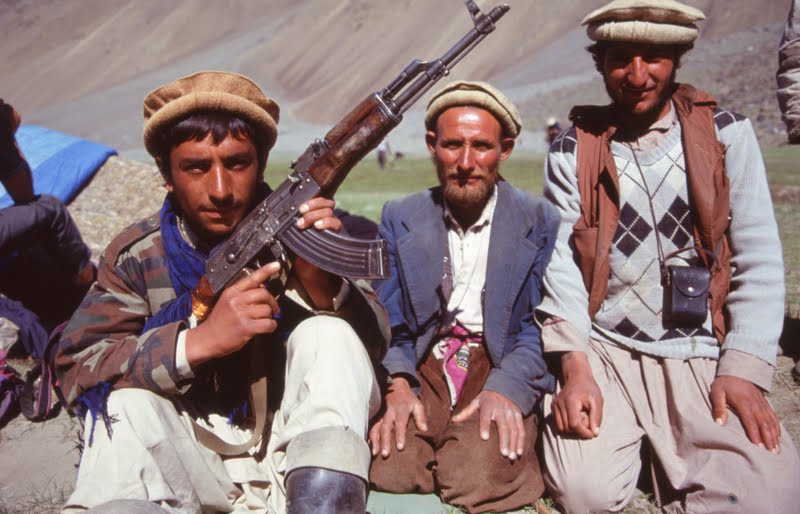
A group of local bandits I photographed and some days later they stole some of our equipment. Photo: Bob McKerrow

This was quite an expedition and the first mistake made, was letting a Frenchman buy the food without supervision. We ended up with pasta, stale and hard bread, rice, onions sugar and tea. There were no breakfast food, no milk powder, no salt, nuts, meat, chocolate meat or sardines. I wrote in my diary after six days we were starving. A group of armed locals stole equipment from us and Mathias was threatened by a soldier with an AK 47.
Approaching the Anjoman Pass from the Panjcher side of the Hindu Kush. In the background are peaks of Nuristan and Mir Sami to the right of centre. photo: Bob McKerrow

It took us five days to cross from the Panjcher Valley over Kotali Anjoman, down to Anjoman village, where we turned a sharp right up a side valley called Darrahe Paghar and set up a base camp at 4300 metres under Kohe Jalgya. The Anjoman Pass seperates Parwan province from Badakhshan province.


Our camp on the northern side of the Hindu Kush with Anjoman Pass the low depression to the right of centre. We spent a day here recovereing from a tiring crossing of the pass. Photio: Bob McKerrow

We soon realised that Kohe Jalgya was quite a technical climb and we didn’t have enough climbing equipment for such an ice climb. So Ross and Mathias headed for Kohe Jalgya and Bruce and I for another less technical climb, an unnamed peak at 5,300 metres.


Bruce Watson on a high point about 4800 metres near to Kohe Jalgya. The range in the background is part of the Jalgya massif. Photo: Bob McKerrow

On the ascent of Kohe Jalgya, Ross and Mathias spent a night half way up the peak. They made good progress the next day but found the ice climbing difficult. After negotiating the hardest part of the climb, they came to a small snow field where they had to plug through waist-deep snow near the summit. They turned back at 4 pm on the 6th of June as the weather closed in. The descent turned into an epic in worsening weather. Mathias had two axes for front pointing down the face, but Ross only had one which slowed him down. Mathias gave Ross one of his ice axes, and he used one axe and an ice screw as a dagger, to descend. About 9 pm, Mathias lost footing and fell down an icy coliour and tumbled head over heals for 300 metres, just coming to a stop before a rocky bluff. Although cut and bruised, he was able to wal on alone trying to find the tent. Meanwhile Ross continued descending alone in the dark on steep ice. Now seperated by 300 metres, Mathias managed to stagger back to their tent situated on a snow ledge. Ross kept down climbing on ice another two hours, reaching the tent at midnight.

Meanwhile at base camp, Bruce and I were anxiously waiting, for they were a day late. We had eaten our last spoon of milk powder, and had no food left, not even a cooker to make tea.

So on Saturday 8 June, Bruce and I left a note and emergency equipment under a rock cairn, and said we were leaving for the valley to buy a sheep, cook it and come up with some locals to effect a rescu

A young boy and his donkey in the Darrahe Paghar valley at the foot of Kohe Japgya. Photo: Bob McKerrow

We got down to a small hamlet in the valley about 4.30 pm and I glanced back at the mountain, and saw two specks slowly moving on the lower snow slopes of the mountain. It could only be Ross and Mathias. Bruce and I were elated. They were alive! We bought a stringy old female sheep and got the farmer to skin it, cut it up and boil it, preparing a feast for Ross and Mathias. Four hours later Mathias and Ross crossed the rising river, and joined us for a feast of mutton. Four days later we were back in Kabul.

Climbing up to the Anjoman Pass from the Badakhshan side. Photo: Bob McKerrow

For further information on mountaineering in Afghanistan, try this:http://bobmckerrow.blogspot.com/2011/08/climbing-and-exploring-in-hindu-kush.html

or this

even better